
ISSN: 0975-248X
CODEN (USA): IJPSPP


Open Access Policy
IJPSDR provides immediate free access to its content on the principle that making research freely available to the public supports a greater global exchange of knowledge, meaning:
The open access policy of the IJPSDR aims at increasing the visibility and accessibility of the published content. Online free access and listing and indexing in a larger number of bibliographic databases add to the high visibility and research impact.
Peer-review Policy
All the manuscripts submitted to the IJPSDR will be subjected to a double-blinded peer-review process. In this model reviewers, and the authors both do not know the identities of each other. We believe this process is the best way to ensure the fairest reviews and opinions on papers.
Initial Evaluation/Technical Review
The Editor(s) first evaluates all the manuscripts. Manuscripts rejected at this stage are insufficiently original, have serious scientific flaws, have poor grammar or English language, or are outside the aims and scope of the journal, or not written as per the journal's guidelines. Those that meet the minimum criteria are forwarded to at least 2 experts for review.
Peer-review
Author's suggestion for the reviewer
The authors can suggest the peer-reviewers as per the following criteria;
Waiver Policy
IJPSDR may grant the partial/full waiver in article processing charges to the authors those are unable to pay the APCs due to financial crisis. Only the authors from low income countries can apply for waiver. Waiver is applicable for one article per year for each submitting author. Please send your waiver requests to [email protected]
Licensing, copyright and author Self-Archiving policies
All the articles published in IJPSDR are distributed under a Creative Commons Attribution 4.0 International Public License (CC-BY 4.0) (read detailed license information here: https://creativecommons.org/licenses/by/4.0/legalcode
This license grants you the following permissions:
To comply with the licensing terms, the authors must ensure the following:
Copyright policy
IJPSDR allows the author(s) to hold the copyright of their work. That means the authors do not need to transfer the copyright of their work to the journal. However, the authors grant IJPSDR a license to publish the article and identify itself as the original publisher.
Author Self-Archiving
IJPSDR allows the authors to self-archive pre-print, post-print, and publishers' versions of the article in any OAI-compliant repository.
Plagiarism Policy
Authors should ensure the originality of their contents, while preparing a manuscript draft. In case the authors have used the work and/or words of others this must be appropriately cited or quoted. All the articles submitted to IJPSDR shall be screened for plagiarism. In case, plagiarism is detected during review/editorial process, such manuscript(s) will be rejected immediately. If the plagiarism is proven after publication, such manuscript(s) will be retracted from the journal and appropriate announcement will be placed in this regard. We can also consider appropriate action against authors depending upon the seriousness of the case. It includes debarring the authors from publication in future. We can bring such instants in notice of author's funding agencies, author's institutes (where they works) and to the original authors whose work has been plagiarized.
Corrections and Retraction
When errors or publication ethics concerns are identified in published articles, the journal will consider the appropriate action and may consult the editor(s), author(s), and the authors’ institution(s). Errors by the authors may be corrected by a corrigendum and errors by the publisher by an erratum.
If there are errors that significantly affect the conclusions or there is evidence of misconduct, this may require retraction or an expression of concern. IJPSDR follows the Committee on Publication Ethics (COPE) retraction guidelines for such cases.
Conflicts of Interest
A conflict of interest defined as any relationship authors, reviewers or editors have, which interferes with the full and objective presentation, peer review, editorial decision-making, or publication of a manuscript. Conflicts of interest can be financial or non-financial, professional or personal, and can arise in relation to an organization or an individual.
All the authors must disclose the possible conflicts of interest/Competing Interests they may have with the publication of the manuscript or an institution or product that is mentioned in the manuscript and/or is important to the outcome of the study presented. Authors should also disclose conflicts of interest with products that compete with those mentioned in their manuscript. The Conflict of Interest statement should list each author separately by name. The ICMJE has developed a Disclosure Form to facilitate and standardize authors’ disclosures, please click this link to download the ICMJE COI form. Authors are required to upload the duly filled and signed form under the additional files section, during manuscript submission. They can also send it by email to [email protected]. Please follow the link to read the detailed ICMJE recommendations for disclosure of financial and non-financial relationships and activities, and conflicts of interest http://www.icmje.org/recommendations/browse/roles-and-responsibilities/author-responsibilities--conflicts-of-interest.html.
ETHICAL APPROVALS
Patient Rights
Patients have a right to privacy thus; all the studies should be conducted with informed consent. No identifying information should be published in written descriptions, photographs, and pedigrees unless the information is essential for scientific purposes and the patient (or parent or guardian) gives written informed consent for publication. When informed consent has been obtained, it should be indicated in the article. Investigations with human subjects must follow the ethical standards formulated in the Helsinki Declaration of 1964, revised in 2013. All the experiment should be approved by the institutional human experimentation committee or equivalent.
Animal Rights
Animal experiments must follow the ethical standards for the care and use of laboratory animals. The article involved animal experiments must seek approval(s) from the appropriate Ethical Committee in accordance with the "Guide for the Care and Use of Laboratory Animals" and CPCSEA guidelines. A statement on ethics committee permission must be included in all research articles.
Clinical trial registry
The journal recommends that the clinical trials should be registered in a publicly accessible database. Authors should include the clinical trial registration numbers on all papers that report their results. The authors must adhere to the minimum set of recommendations for reporting randomized trials as described in "The CONSORT (Consolidated Standards of Reporting Trials) 2010 guideline".
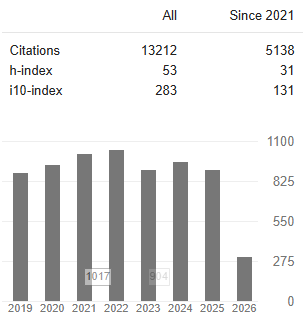
Citation Indices
Quick Links
 International Journal of Pharmaceutical Sciences and Drug Research is licensed under a Creative Commons Attribution 4.0 International Public License (CC-BY 4.0). Based on a work at https://ijpsdronline.com. Permissions beyond the scope of this license may be available at https://ijpsdronline.com/